

Wool Coats
Breed examples include Poodles, all Poodle crosses, Bichon's and Irish Water Spaniels.
Wool coats are one of the highest maintenance coat types and are none shedding. These coats must be brushed regularly to prevent matting.
It is recommended that wool type coats are professionally groomed every 6-8 weeks.
Understanding your dogs coat
When puppies are born they often have two or three fluffy undercoat hairs per follicle and sometimes one guard hair (although guard hairs often don’t grow until after 3 months of age). In comparison, humans have only one hair per follicle and this number does not change throughout our lives.
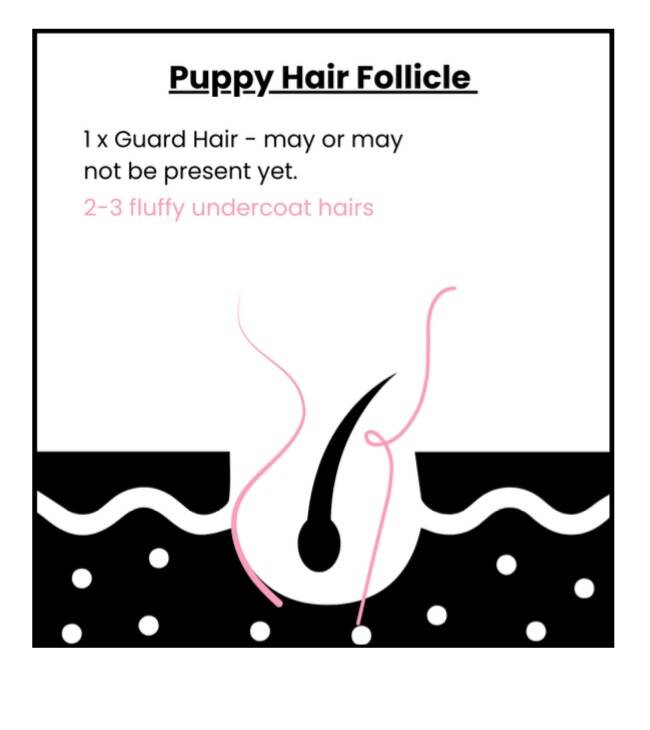
Between 6-12 months of age, dogs go through what we call “coat change” and they begin to grow more secondary hairs per follicle, plus their adult guard hair comes through fully. There are sometimes up to 12 hairs per follicle now. This is the adult coat coming in.
This is why puppy hair often seems so floppy and easy to maintain. Training your dog to enjoy grooming as a puppy may seem pointless (when their hair is light and floppy) but it is much easier than trying to train an adolescent dog to be groomed when they now have an adult coat coming in.

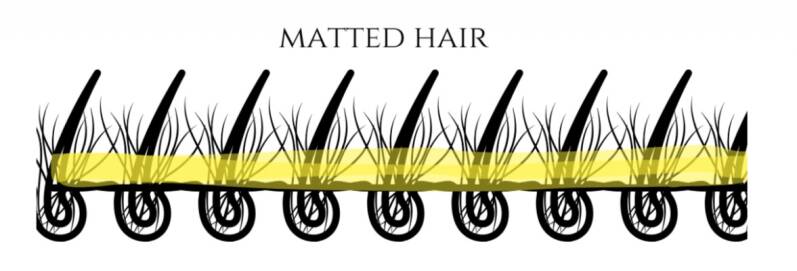
The coat of an adult is thicker, especially at the roots and the 2cm nearest to the skin. Unless brushed and combed out regularly at home with proper techniques and tools, this hair nearest to the skin can often become matted. Unfortunately if this hair becomes matted to the point where each hair is not separate to the hair next to it (you should be able to part your dogs hair anywhere on their body and see healthy skin), then the only humane option is to shave your dog. As matting occurs at the level closest to the skin, this is the level at which your dog will get shaved to get under the matting.
Dangers of matting to your dog
Not only is matting painful and uncomfortable for your dog as it pinches your dogs skin, it also has potential dangers.
As an owner you might be reluctant to have your dog shaved short, not just for aesthetic reasons but also due to fears of your dog being cold for example. However, here is what matting does to your dog:
- Imagine a patch of your dog’s skin covered in adult hair follicles (remember the diagram above?) All the hairs intertwining and tangled with the hairs next to them. Underneath all these hairs the skin is getting less and less air passing over it. A little bit like a canopy of jungle trees protecting the jungle floor from the sun.
- Your dog struggles to thermoregulate (control their temperature) due to the skin getting less and less air passing over it. If the hair and the skin get damp on a wet walk or even walking through damp grass, the dampness stays next to the skin as it struggles to dry quickly with no circulating air.
- This actually makes your dog colder and the damp skin can eventually become chapped. Constant dampness will also make your dog a lot colder than shaving off the coat and starting again. This chapped damp skin can also cause rashes and irritation, causing your dog to scratch or nibble at the area and constantly make the matting worse. These rashes are often revealed when a groomer releases the dog from the matting by shaving off the pelted hair. These rashes are not caused by the groomer, nearly revealed.
If you would like some tips on how to groom your dog in between grooming appointments please ask at your dogs next appointment and I will be more than happy to show you.
Create Your Own Website With Webador